Executive Summary
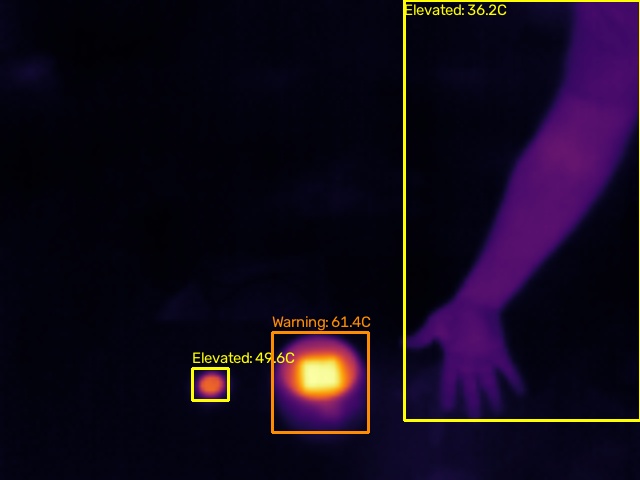
The AeroTherm system is a fully autonomous, heavy-lift drone designed for Search and Rescue (SAR) and industrial inspection. Designed to bypass standard relative thermal vision, the system integrates a headless Raspberry Pi 3 A+ and a FLIR Lepton 3.5 to detect, categorize, and log absolute temperature anomalies in real-time.
Tech Stack: Python, OpenCV, PixHawk 6C, ArduPilot, SPI/I2C, ROS 2, Linux.
Documentation: View the official publication on Hackster.io
System Architecture
To process absolute radiometric data at 26Hz while maintaining stable autonomous flight, the system separates flight dynamics from the compute payload.
1. Hardware & Fabrication
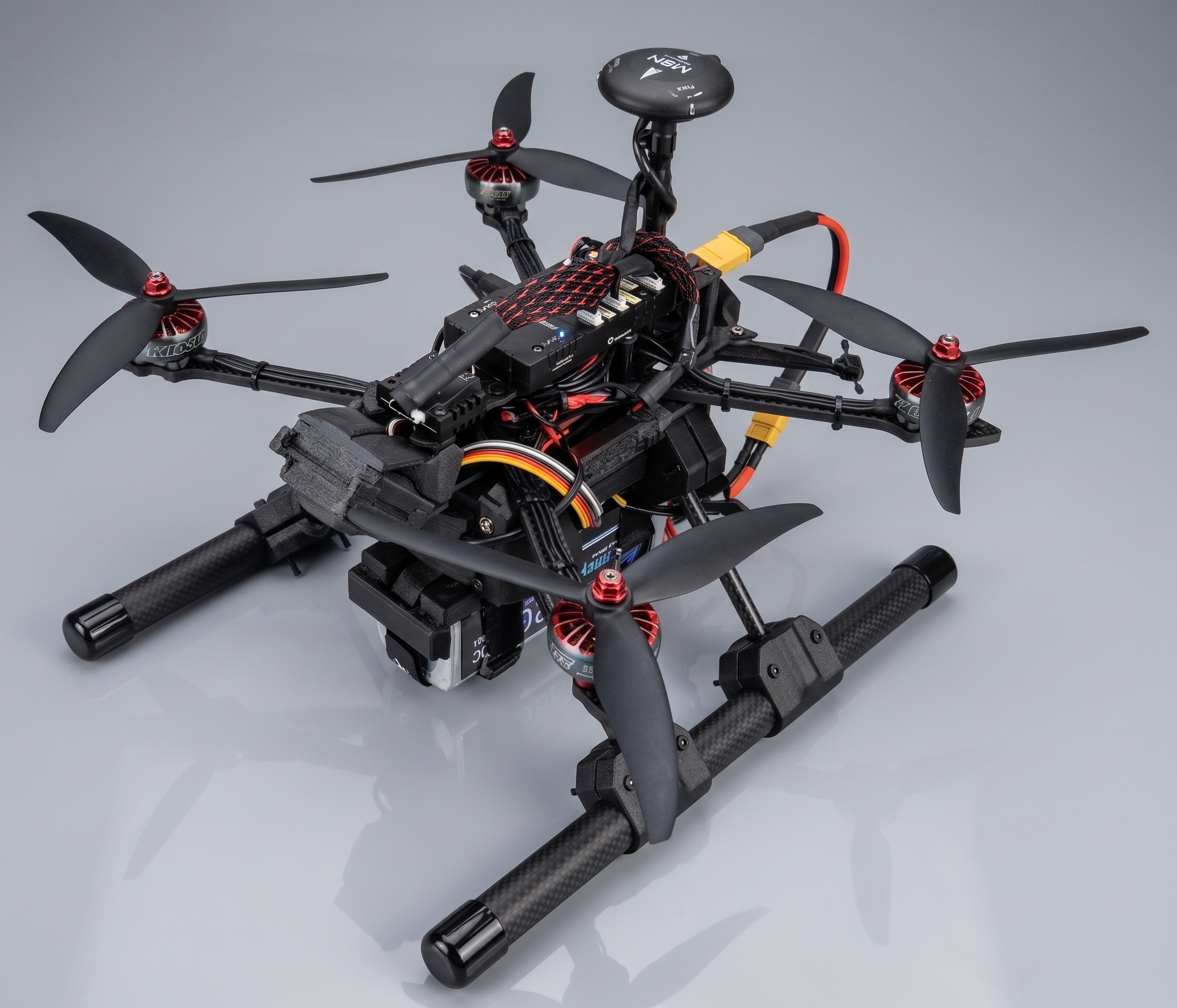
The physical chassis was engineered for high rigidity and payload capacity, coming in at a 1588g All-Up Weight (AUW).
- Materials: Custom structural mounts printed in PETG-CF utilizing a Bambu Lab X1-Carbon, integrated onto a 7-inch Mark4 carbon fiber frame.
- Power Isolation: A custom power delivery system utilizing a Matek 12S BEC. This ensures the 5V logic hardware (Raspberry Pi and PixHawk) are safely isolated from the raw 6S LiPo voltage feeding the ESC.
2. Perception-to-Action Pipeline (Python)
The core brain operates on a Raspberry Pi 3 A+, utilizing a custom Python daemon to extract raw 16-bit VoSPI arrays from the FLIR Lepton 3.5. The Python backend applies absolute Celsius conversions and utilizes a localized threshold dictionary to trigger automated captures upon detecting specific heat signatures.
# Core logic snippet: Fault-tolerant SPI architecture for headless execution
import spidev

def thermal_capture_thread():
    spi = spidev.SpiDev()
    spi.open(0, 0)
    spi.max_speed_hz = 16000000

    try:
        while True:
            frame = get_lepton_frame(spi)
            process_thermal_data(frame)
    except Exception as e:
        log_fatal_error(e)
    finally:
        spi.close()